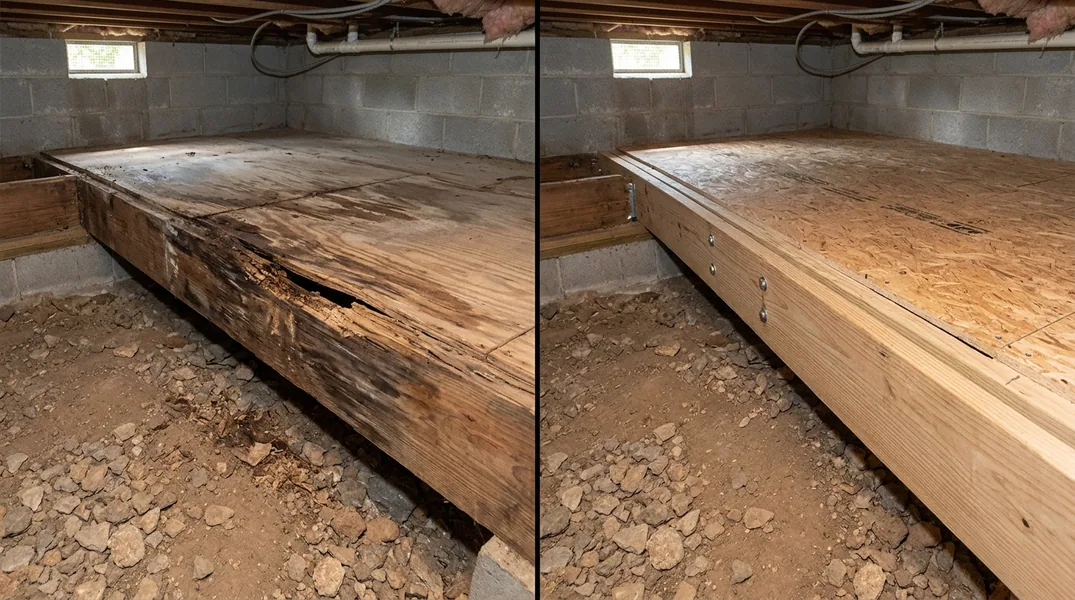
Why Crawlspace Moisture Causes Sagging Floors
If you've noticed your floors dipping or feeling soft underfoot, especially in older homes or those with crawlspaces, moisture is likely the culprit. Murfreesboro homeowners frequently face this issue because of our humid climate and seasonal water intrusion. When moisture accumulates in a crawlspace, it doesn't just sit there. It actively attacks the wooden structural components that hold your home up, particularly the floor joists and support beams.
Floor joists are the horizontal wooden members that span between foundation walls or beams and support your subfloor and flooring. When exposed to prolonged moisture, these joists absorb water and begin to soften. Wood loses its load-bearing capacity as it becomes waterlogged, and the joists start to compress under the weight of your home. This compression happens gradually, which is why many homeowners don't notice sagging until it becomes severe. The problem compounds when wood rot enters the picture, further weakening the structural integrity of the joists.
How Wood Rot Accelerates Floor Failure
Wood Rot & Dry Rot Repair is essential when moisture problems go unaddressed. Dry rot, despite its name, thrives in damp conditions and spreads through wood fibers, creating hollow cavities that look deceptively minor from the surface. Wet rot is equally destructive, causing wood to become spongy and weak. In crawlspaces, both types of rot can develop unnoticed for months or even years because homeowners rarely inspect these dark, confined spaces.
The real danger is that rot doesn't just affect one joist. It spreads laterally along beams and from joist to joist, especially if there's standing water or continuous moisture. A single rotted joist might seem manageable, but when rot compromises multiple joists across a span, the floor loses its ability to distribute weight evenly. This is when you'll feel that telltale bounce or sag in your flooring. In severe cases, rot can weaken joists so much that they fail completely, causing sudden floor collapse or dangerous structural shifts.
The Process of Floor Joist Repair and Sistering
Floor Joist & Subfloor Repair typically involves one of two main approaches: complete joist replacement or sistering. Sistering is a technique where a new joist (or reinforcement beam) is attached alongside a weakened or damaged original joist. This method is often preferred because it preserves the original structure while restoring strength and load capacity. The sister joist is bolted or nailed securely to the damaged joist, creating a doubled beam that can handle the structural demands your home requires.
The repair process begins with a thorough inspection of the crawlspace to identify all affected joists and determine the extent of rot or water damage. Once compromised joists are located, the crawlspace must be dried out and moisture sources eliminated before repair work begins. If water is still present, any new repairs will fail just as quickly as the originals. After drying, damaged sections are either reinforced through sistering or completely replaced if rot is too extensive. The choice depends on the severity of damage and the overall condition of the joist.
Properly executed sistering requires precision. The sister joist must be cut to the correct length, positioned tightly against the original joist, and fastened with structural-grade fasteners spaced according to engineering standards. This isn't a DIY project for most homeowners. Improper sistering can leave your floor just as weak as before, or worse, create new structural problems. That's why hiring experienced professionals in Murfreesboro is so important for this work.
Addressing Crawlspace Moisture in Tennessee
Crawlspace moisture is the root cause, so fixing sagging floors means fixing the moisture problem first. Murfreesboro sits in a region with high humidity and significant seasonal rainfall, making crawlspace moisture nearly inevitable without proper ventilation and moisture control. Common sources include poor drainage around the foundation, missing or damaged vapor barriers, inadequate ventilation, and plumbing leaks. Some crawlspaces also experience groundwater seepage if the water table is high or if grading slopes toward the foundation.
The solution usually involves multiple steps. First, a proper vapor barrier (typically 6-mil polyethylene sheeting) should cover the crawlspace floor to prevent ground moisture from rising into the space. Second, gutters and downspouts must direct water away from the foundation, ideally at least 4 to 6 feet out. Third, crawlspace ventilation should be adequate, though over-ventilation in humid climates can actually worsen moisture problems. Many modern solutions include installing a crawlspace dehumidifier or encapsulation system to maintain dry conditions year-round. These preventive measures protect your new repairs and extend the life of your home's structural components.
Signs Your Home Needs Floor Joist Repair Near Me
Recognizing the warning signs early can save you thousands in repair costs. If you notice your floors sagging, bouncing, or feeling soft in certain areas, that's a red flag. Visible mold or mildew in the crawlspace indicates moisture problems. A musty smell coming from below the floorboards suggests rot is developing. Cracks in drywall or plaster, especially diagonal cracks, can indicate structural settling caused by failing joists. Doors or windows that suddenly stick or won't close properly might also point to floor movement.
Some signs are more subtle. If your hardwood floors are cupping (edges higher than the center) or if you notice gaps appearing between floorboards, moisture is likely the cause. Pest infestations, particularly termites or carpenter ants, often accompany moisture problems and can compound structural damage. If you're experiencing any of these issues, it's time to get a professional inspection. A qualified carpenter can crawl under your home, assess the condition of joists and beams, and determine whether you need repairs now or preventive work to avoid future problems.
Getting Your Sagging Floors Fixed: Next Steps
Addressing sagging floors requires a comprehensive approach that tackles both the immediate structural problem and the underlying moisture issue. Murfreesboro Carpentry specializes in exactly this type of work, with years of experience repairing floor joists, sistering damaged beams, and solving crawlspace moisture problems that plague homes throughout the region. Our team understands the specific challenges that Tennessee's climate and soil conditions create for homeowners.
The first step is to schedule a free estimate so we can inspect your crawlspace and determine what repairs your home needs. We'll provide you with a clear, honest assessment of the damage, explain your repair options, and give you transparent pricing before any work begins. Don't let sagging floors worsen. Structural problems compound over time, and what could be a manageable repair today can become a major expense tomorrow. Call Murfreesboro Carpentry at (629) 219-2900 to schedule your inspection and take the first step toward a solid, safe home.
Looking for a professional carpentry contractor in Murfreesboro? Murfreesboro Carpentry responds fast for all your carpentry needs.
Get a Free QuoteOur services: Wood Rot & Dry Rot Repair · Termite Damage Repair · Floor Joist & Subfloor Repair