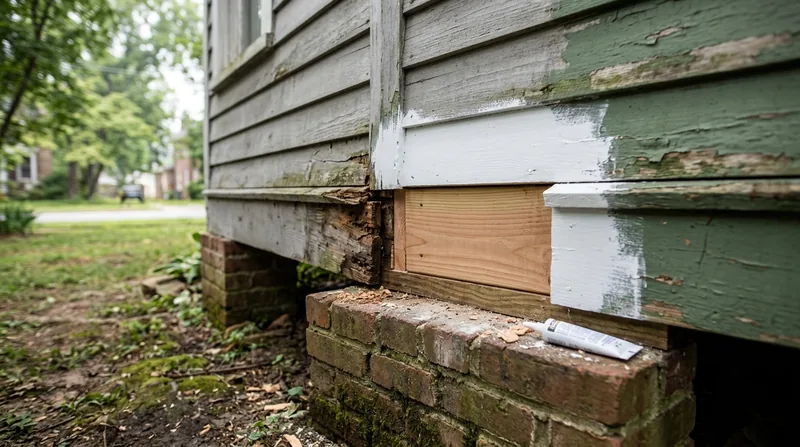




Murfreesboro's East Main Street Victorians, bungalows near Middle Tennessee State University, and the raised-pier cottages scattered through older neighborhoods all share a common enemy: wood rot driven by the region's muggy summers and soaking rains. The Stones River valley holds moisture in sills, rim joists, and porch framing far longer than it should, and freeze-thaw cycles crack exterior joints each winter. Wood Rot and Dry Rot Repair in Murfreesboro means cutting out the soft, compromised wood, treating the sound framing around it, and rebuilding with rot-resistant lumber so the repair lasts, not just looks fixed. We don't paint over decay or patch with filler. We remove the problem, diagnose what let the moisture in, and replace it with wood that will stand up to another hundred years of Middle Tennessee weather.
Why Wood Rot Matters in Murfreesboro: Climate and Framing at Risk
Murfreesboro sits on thin, rocky clay over flat limestone, and the Central Basin's damp summers combine with frequent heavy rains to keep wood saturated long after the weather clears. Sill plates and rim joists on Craftsman bungalows and Victorian porches absorb water from the ground and from backed-up gutters. Fascia and soffit on 1950s ranches over vented crawlspaces collect condensation on cold mornings. Porch decking and trim on historic homes near the courthouse square get soaked during spring downpours and freeze solid in winter. Carpenter bees drill into exposed rafter tails and fascia boards. Eastern subterranean termites swarm each spring and tunnel through rim joists and band board. Over time, dry rot and wood decay soften the framing until floor joists sag, porch posts lean, and exterior trim splits and fails. Small repairs catch early, but delayed action turns a $1,200 sill plate replacement into a $6,000 floor joist and subfloor job.
- We identify the source of moisture and recommend gutters, drainage, or ventilation changes to stop re-wetting.
- We probe and sound the wood to separate what can be saved from what must come out.
- We cut out all soft and compromised framing in a clean line and replace it with pressure-treated or naturally rot-resistant lumber.
- We treat exposed sound wood with a wood preservative to arrest early decay and protect the repair.
Catching rot early prevents structural damage and keeps repair costs reasonable.
Key info: A Victorian sill plate showing soft spots on East Main Street can often be cut and sistered with new lumber, saving the historic porch posts and foundation line. The same damage left for two more years may require full joist replacement and temporary support, tripling cost and disruption.
For more on structural framing damage, see our Termite Damage Repair and Floor Joist and Subfloor Repair pages. Many Murfreesboro homeowners face both wood rot and termite tunneling on the same job.
For information on permits and local requirements, consult the City of Murfreesboro Building and Codes Department if your repair involves structural alteration or exterior work on a historic property.
How We Repair Wood Rot and Dry Rot in Murfreesboro: Step by Step
Our approach is straightforward: identify the decay, remove it cleanly, treat the surrounding sound wood, and rebuild with lumber that won't fail again. We don't guess at hidden rot or assume the problem is bigger than it is. We probe, we measure, and we explain what we find before we start cutting. For a bungalow near MTSU with a soft rim joist, a Victorian porch with a rotted post, or a 1950s ranch with water-damaged floor joists over a crawlspace, the method stays the same but the scale and access change the labor and timeline.
- We inspect the area with a moisture meter and decay probe to map the extent of soft wood and identify the moisture source.
- We remove trim, siding, or flooring as needed to expose the full extent of decay and the sound wood beyond it.
- We cut out all compromised framing in a clean line perpendicular to the grain, leaving only sound wood.
- We treat the cut surfaces and exposed framing with a wood preservative to slow any residual decay.
- We size and install new lumber (pressure-treated, redwood, or Douglas fir) to match the original framing and load requirements.
- We fasten, seal, and restore trim and siding to shed water and protect the repair for decades.
The entire job is documented so you can file for insurance reimbursement if the damage was sudden and covered by your policy.
Example: A Murfreesboro homeowner on Northfield Boulevard noticed water staining on the basement rim joist after heavy spring rain. We found 14 inches of soft rim board on the north side where a downspout had eroded the grade. We cut out the decay, sistered new pressure-treated lumber to the remaining rim, rerouted the downspout, and sealed the crawlspace vent. Cost was under $2,000. Ignored, that same damage would have reached the floor joists and subfloor within two years, turning into a $8,000 job.
Learn more about structural repairs and when sistering or full replacement is the right choice on our Framing and Structural Carpentry page.
Wood Rot Repair Methods: Repair vs. Replace
| Approach | Description | Best For |
|---|---|---|
| Sistering | Bolt or lag a new beam or joist alongside the damaged one, sharing load and restoring strength without removing the original. | Sill plates, rim joists, and floor joists where decay is localized and the original framing is still sound enough to carry temporary load during repair. |
| Scarf Joint | Cut the decayed section at an angle and lap a new piece of matching lumber over the cut, fastening with bolts or screws for a continuous grain line. | Porch posts, trim boards, and fascia where appearance and structural continuity matter and decay is at an end or joint. |
| Full Replacement | Remove the entire damaged member and install new lumber cut to the original dimensions and species when possible. | Structural beams, band boards, and framing where decay has compromised more than half the member or where the wood is load-bearing. |
| Localized Cut and Replace | Excise only the soft wood in a clean perpendicular cut and splice new lumber into the void with bolts, fasteners, and epoxy where needed. | Porch decking, window sills, and exterior trim on Victorian and Craftsman homes where partial decay allows repair without losing historic fabric. |
The right method depends on the member's role in the structure, the extent of decay, and whether the original wood is worth preserving. We assess each job on site and recommend the most durable and cost-effective solution.
Wood Rot and Dry Rot Repair Cost in Murfreesboro: What to Expect
Wood rot repair in Murfreesboro typically starts at $650 for a small, accessible area like a single window sill or a short section of fascia. Most rim joist and sill plate repairs on bungalows and Craftsman homes run between $1,200 and $3,500 depending on the length of damage, access, and whether the crawlspace or basement is tight. A full floor joist or major porch post replacement can reach $5,000 to $10,000 or more if multiple joists are involved or if the job requires temporary support and staged work. Travel is included in Murfreesboro and surrounding areas, and we provide a free estimate within 24 hours at (629) 219-2900.
What moves cost up or down:
- Extent of decay: a 2-foot section of rim board costs far less than 12 feet.
- Access: a porch post visible from grade is faster than a joist in a tight crawlspace or under a finished floor.
- Load-bearing status: a simple trim repair takes half the time of a structural joist that needs temporary support during replacement.
- Moisture source: if gutters, grading, or ventilation must be corrected to stop re-wetting, that work adds to the total.
- Lumber choice: pressure-treated stock costs less than redwood or Douglas fir, which may be chosen for appearance or durability on historic homes.
Get two or three estimates so you understand the scope and can compare approaches. Some contractors recommend full replacement when repair is still sound; others skip the moisture diagnosis and leave the root cause untouched. We explain what we find and propose the most cost-effective fix that will last.
For detailed pricing and examples across different repair types, visit our Pricing page.
Wood Rot and Dry Rot Repair Near Me: What to Look for When Hiring a Carpenter in Murfreesboro
Finding the right carpenter for wood rot repair means checking three things: whether they understand the local climate and the moisture patterns that drive decay in Murfreesboro, whether they explain the repair method and why it's the right choice, and whether they're insured and willing to document the damage for your insurance claim. A good contractor will probe the wood, identify the moisture source, and tell you plainly whether repair or replacement is honest. They'll get a permit if the work touches a historic property or a load-bearing wall. They'll give you a written estimate with materials and timeline. And they'll answer your questions without pressure.
- Ask whether they've worked on homes built in the 1880s to 1920s in the East Main Street historic district or near MTSU, since those homes have similar framing and moisture challenges.
- Request references from recent jobs in Murfreesboro, La Vergne, or Smyrna, and ask about the moisture issue and how it was fixed.
- Confirm they are fully insured and can provide a certificate of insurance before work begins.
- Check whether they understand permit requirements for structural work or repairs on historic properties, and ask the City of Murfreesboro Building Department about any thresholds for your job.
- Get a detailed estimate that breaks down materials, labor, and the scope of the repair, and ask what happens if the decay extends beyond what's visible.
Don't hire the cheapest bid or the fastest timeline. Hire the carpenter who listens, explains, and stands behind the work with a warranty and insurance.
Ready to get started? Contact us for a free estimate at (629) 219-2900. We respond within 24 hours, and there's no obligation to book.
Wood Rot & Dry Rot Repair in Murfreesboro: Pricing Guide
| Service | Price | Details |
|---|---|---|
| Small trim and sill repair | Starting at $650 | Window sill, fascia section, or small trim board; includes removal, treatment, and replacement with rot-resistant lumber |
| Rim joist or sill plate repair | Starting at $1,200 | Sistering or partial replacement on accessible rim board or sill; cost increases with length of decay and crawlspace access difficulty |
| Floor joist or major structural repair | Starting at $3,500 | Full joist replacement, multiple members, or work requiring temporary support; final cost depends on number of joists and staging requirements |
| Porch post or load-bearing member replacement | Starting at $2,800 | Historic or decorative post, scarf joint repair, or full replacement; cost varies with post height, detail, and temporary support needed |
| Moisture diagnosis and prevention | Included in estimate | Inspection, probing, and identification of gutters, grading, or ventilation changes needed to stop re-wetting and future decay |
| Free estimate | No charge | Response within 24 hours at (629) 219-2900; no obligation to book; includes site visit and detailed scope assessment |
Indicative pricing, the exact cost depends on square footage, finish, and site access. Free personalized estimate within 24h at (629) 219-2900.


